

Why Regional Carriers Turn to Employer of Records Services Instead of In-House HR

Ideally, a regional carrier with 50 trucks does not need a standalone HR department. On paper, that might sound reckless, especially if your fleet is adding trucks and your compliance workload gets heavier every quarter. But building a human resources team from scratch isn’t the only way to go. And for most mid-size carriers, that is not the smartest thing, which is why employer of record is gaining traction.
More than ever, regional trucking companies are outsourcing HR to employer-of-record services. Payroll and benefits administration, workers' compensation, multi-state tax filings, and driver qualification recordkeeping all go to an EOR specialist like Forsla. While the carrier controls the routes & driver management. With the Supreme Court's Montgomery ruling raising the bar on carrier compliance this year, the pressure behind that shift is real. This article discusses why this is happening, and when it makes the most sense for your operation.
What a Regional Carrier's HR Workload Actually Looks Like
Carriers specialize in moving freight. What most of them didn’t sign up for is running a small human resources department on top of that. And as fleets grow beyond a few trucks and begin hiring across state lines, administrative burdens quickly mount.
1. Driver Qualification and Safety Records
Each truck driver on your list requires a qualification file that is compliant with federal standards. This includes checking CDLs, medical certificates, motor vehicle records, and employment history for the past 10 years, and conducting drug and alcohol testing in accordance with DOT rules. Another step is background checks. They must all be kept up to date, stored properly, and available for inspection at a moment’s notice. Miss a renewal date or leave files incomplete, and the entire fleet faces compliance risk, legal exposure, and potential penalties.
2. Multi-State Payroll and Employment
A Texas-based carrier that hires a driver in Georgia, for example, now owes Georgia payroll taxes, state-specific workers' compensation coverage, and compliance with Georgia’s employment laws around wages and leave. Do that in six or seven states and payroll administration alone can swamp a small back office. Each state has its own rules for withholding rates, benefit mandates, and reporting schedules. Those rules rarely line up.
3. The Hiring Lifecycle
The paperwork to bring a new driver on board takes days before that person turns a wheel, starting with finding the right candidate before the onboarding steps begin. HR has to do the whole employment verification, tax forms, benefits enrollment, and safety orientation, along with common hiring pain points during onboarding and offboarding. And then there’s the constant record-keeping. If the driver leaves, offboarding has its own compliance trail. The full cycle is time-consuming for any carrier, and the cost of getting it wrong goes beyond fines. It shows up in churn.
How the Montgomery Ruling Raised the Compliance Bar for Carriers
On May 14, 2026, in Montgomery v. Caribe Transport II, LLC, the U.S. Supreme Court unanimously ruled that freight brokers can be sued for negligence under state law for hiring unsafe carriers. The 9-0 ruling wiped out the federal preemption defense that brokers had relied on for decades and changed how every broker in the country viewed the carriers on their load boards.
Brokers are vetting harder. Transportation attorney Matthew Leffler has noted that 94% of motor carriers lack a formal FMCSA safety rating. In a world where brokers must justify the carriers they use in court, fleets with messy compliance and missing driver qualification files will lose loads to their cleaner competitors with an unblemished record. After Montgomery, documentation is no longer a back-office task.
How a Trucking Company Benefits from an Employer of Record
An employer of record handles the legal employment of your drivers, so you can focus on running operations. You still choose who to hire, assign loads, and deal with performance, while the EOR legally employs your organization's employees for payroll, tax, benefits, and compliance. This is not a staffing agency that sends you workers you didn’t choose and could rotate between carriers.
An EOR lets you build your own team while it manages the employment administration behind it. This is beyond the typical HR outsourcing where a carrier may outsource recruiting or payroll processing as separate functions. An EOR is the legal employer in totality. EOR services can save time and improve efficiency by consolidating payroll, benefits, and compliance administration. That means it will handle your wages, tax withholdings, quarterly filings, and year-end reporting in each state where your drivers operate. You won’t have to set up separate legal entities in each state, or keep track of the ever-changing tax codes between jurisdictions.
Benefits and workers' compensation follow the same model. Different states have different coverage mandates. Some states require policies that neighboring states do not. EOR handles enrollment, tracks requirements, and makes sure your coverage is compliant with local employment laws where your drivers are located. This same model can also support expansion into other countries without requiring you to establish your own entity.
The EOR also maintains employment records that will withstand scrutiny. Driver qualification files, drug testing logs, and worker classification records are kept in an audit-ready state. Such recordkeeping now distinguishes carriers that land broker contracts from those that get passed over. When comparing providers, review where they offer direct coverage and what services are included.
EOR vs. Creating an Internal HR Department
If you want to have control over your operations, building your own HR team sounds like the right approach. But the costs comparison is a different story for most carriers operating 20 to 75 trucks.
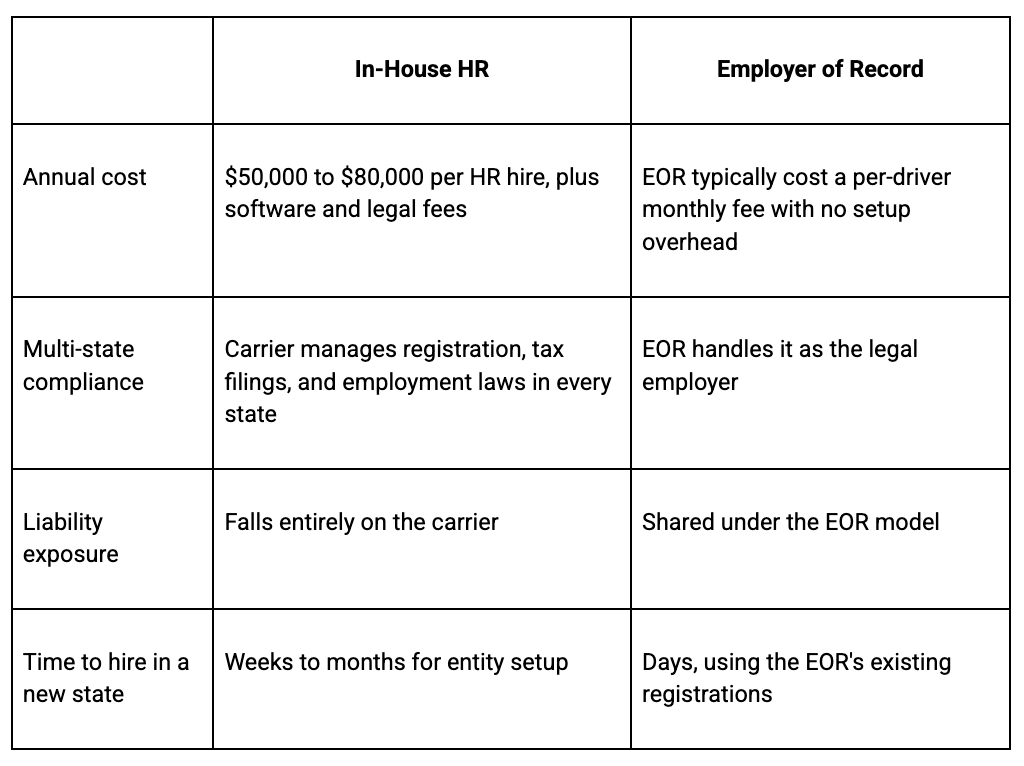
An EOR is a shared burden. The money a carrier would spend on salaries, HR software, benefits platforms, and outside legal counsel is instead redirected to a third-party provider that already has the state registrations, legal entities, and state-by-state knowledge, and this is often more cost-effective than setting up your own entity because it avoids upfront setup and ongoing administrative costs. For carriers that are strapped for cash, that trade saves time and cash that can be put back into freight while creating operational efficiencies for fleets with limited resources.
When an EOR Is Right for a Regional Carrier
Not all carriers need an EOR. A one-state business with five trucks and a good bookkeeper can probably do its own payroll and compliance filings. The fit gets clearer as the fleet expands and the geography widens.
The greatest friction with employment laws and regulations shows up for carriers that run routes through five or more states and hire truck drivers in each state, where it gets harder to ensure compliance. So do companies testing a new market before committing to full state registration, especially if they want to enter new states without building their own HR functions first. Most small carriers do not have time to stay on top of regulatory changes in eight states. An EOR fills that gap without you having to build a whole department if there is no compliance person or HR manager on staff. After Montgomery, carriers who want to stay ahead of tighter broker vetting need records that can pass a compliance audit on short notice. An EOR protects the carrier through stronger regulatory compliance and practical risk management when compliance staffing is thin.
How Forsla Helps Regional Carriers Manage Driver Employment
Forsla provides EOR services specifically for trucking companies and owner-operators. We provide service for W-2 company drivers and 1099 independent contractors and have a back-end partnership with TCWGlobal for administration processing.
Forsla handles payroll, multi-state tax filings, DOT compliance, benefits administration, occupational accident insurance, and driver onboarding in every state a carrier operates. Transparent, per-employee pricing, scaled by fleet size, driver classification, and regional coverage. The same services can reduce administrative overhead and compliance gaps for carriers. Forsla’s compliance team provides continuous support through documentation audits and regular checks, keeping records up to date so dispatchers and fleet managers aren’t chasing paperwork from load to load. Request a quote today to get started.
Frequently Asked Questions
Is a carrier still legally responsible for drivers hired through an EOR?
The EOR takes on the legal employer role for payroll taxes, regulatory requirements, and worker classification. The carrier manages routes, schedules, and driver performance. Compliance responsibilities shift to the EOR, which reduces exposure to misclassification penalties and audit findings. Daily business operations stay under the carrier's control.
What is the difference between an EOR and a professional employer organization?
An EOR becomes the sole legal employer and takes full responsibility for payroll, employment laws, and compliance. A professional employer organization uses a co-employment model where the PEO and carrier share employer duties. Carriers that want cleaner separation of risk and liability across state lines tend to prefer the EOR structure.
Can an EOR help a carrier hire drivers in new markets quickly?
Yes. The EOR already holds registrations in multiple states, so carriers can onboard employees within days rather than waiting weeks for entity setup. No need to register with a new tax authority or navigate unfamiliar local laws on your own. The existing infrastructure removes the delays that make expansion time-consuming.
Can an EOR help a trucking company hire international workers?
Many EOR providers support international employment, allowing carriers to hire employees in a foreign country without setting up a local entity. The EOR manages payroll in local currencies, handles social security contributions, and maintains data security standards while staying compliant with local laws. This works for carriers looking to expand globally or build a global team across multiple countries.
Can carriers attract top talent by hiring through an EOR?
Yes. A strong EOR gives carriers access to competitive benefits packages, including health coverage and retirement options, that a smaller fleet might struggle to offer on its own. Drivers weigh benefits heavily when choosing between offers. The right employer of record helps carriers compete for the right candidates without having to build a benefits program from the ground up.