

Beverage Logistics: Cold Chain Strategies for Temperature-Sensitive Goods
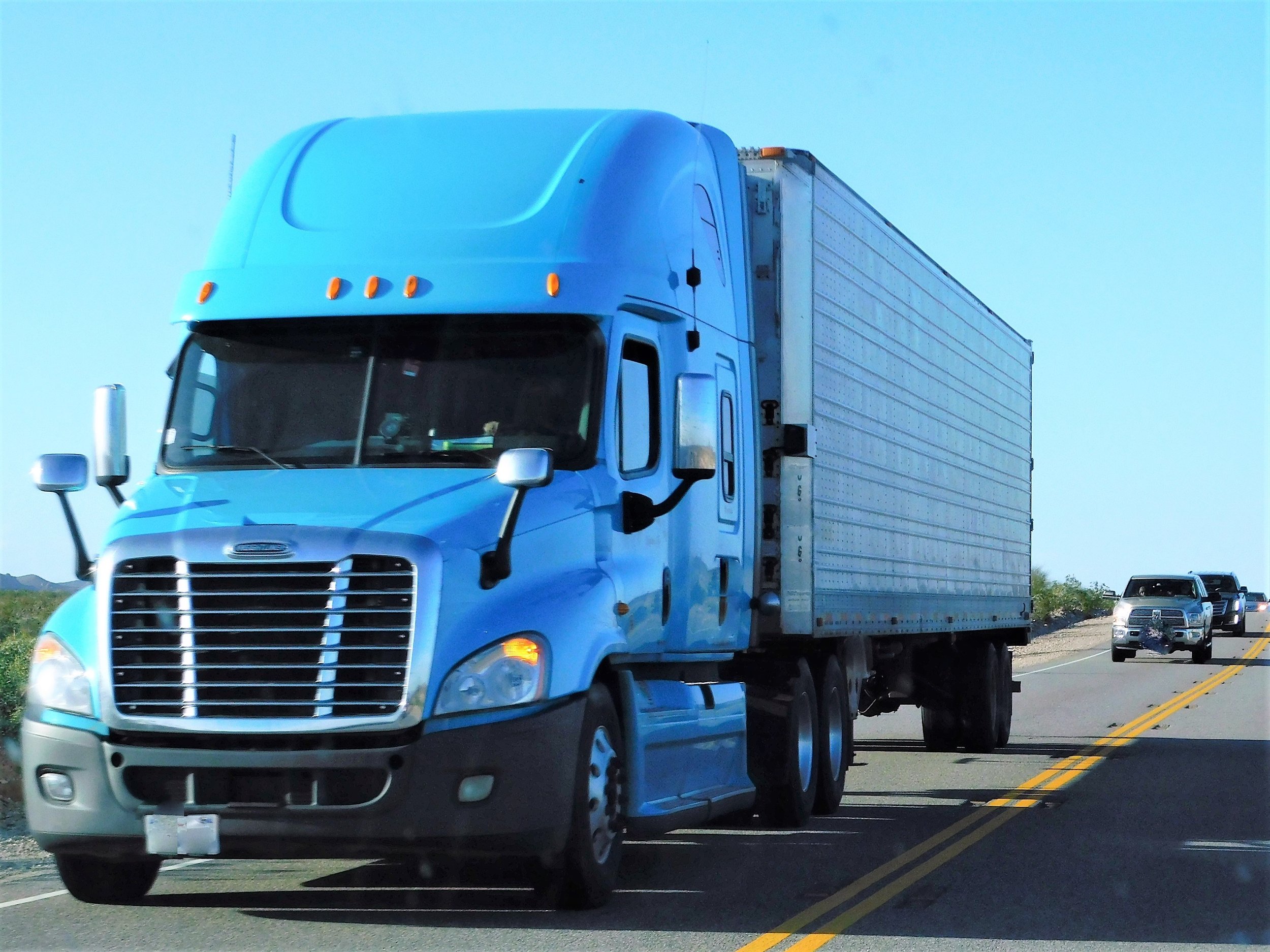
Beverages are one of the most demanding product categories in freight. They are heavy, fragile, temperature sensitive, and consumed on tight schedules. A single pallet of bottled water can weigh over 2,000 lbs. A case of craft beer can lose its flavor profile if stored above 55°F for just a few days. A cold-pressed juice exposed to a four-hour temperature spike may become unsafe to drink.
That is why beverage logistics requires more than a truck and a loading dock. It requires a coordinated system of cold chain logistics, proper handling protocols, appointment scheduling, and regulatory compliance designed specifically for liquid goods.
Cold chain logistics solutions are tailored to support different business needs and enhance overall business operations. And with the global food and beverage cold chain logistics market valued at roughly$90 billion in 2025 and projected to reach $219 billion by 2034, the stakes have never been higher for brands that ship perishable or temperature sensitive goods.
This article breaks down what beverage logistics actually involves, why it matters for your brand, and how to evaluate a logistics provider that understands the constraints of the beverage industry. Effective cold chain logistics are essential for ensuring product quality and continuous monitoring to preserve the integrity and safety of beverages. Compliance with regulations not only helps companies avoid legal issues and potential fines but also builds trust with customers.
What Is Beverage Logistics?
Beverage logistics is a specialized segment of supply chain management focused on the transportation, warehousing, and distribution of liquid consumables. This includes everything from carbonated soft drinks and bottled water to craft beer, wine, cold-pressed juice, dairy drinks, functional beverages, and spirits.
Unlike standard freight, beverages come with a specific set of operational constraints. The products are dense and heavy. This means weight distribution matters more during loading and transport. Many are sold in glass or aluminum packaging, making them susceptible to breakage. And a large number of SKUs are perishable items. These require strict temperature control from the production facility to the retail shelf. Other industries, such as meat and pharmaceuticals, also rely on cold chain logistics to maintain product safety and quality.
Beverage logistics services go beyond simple point-to-point transport. They include cold storage coordination, appointment scheduling with retail distribution centers, temperature controlled packaging validation, damage prevention strategies, and regulatory compliance documentation. For brands shipping regionally or nationally, working with a logistics partner that understands these unique needs is the difference between consistent delivery and costly spoilage.
Why Temperature Control Is the Foundation of Beverage Logistics
Temperature fluctuations are the single biggest threat to beverage quality during transit. Even a few degrees outside the target range can degrade flavor. You might see a compromise in carbonation, accelerated microbial growth, or significantly reduced shelf life when temperatures change and your cold chain logistics are unable to deliver. Maintaining proper temperature is also essential for preserving the freshness of beverages and other perishable goods throughout transit and storage.
How Temperature Impacts Shelf Life
Different beverage categories have different tolerances.
Craft beer stored above its optimal temperature range oxidizes faster, producing off-flavors that consumers immediately notice.
Cold-pressed juice is highly perishable and loses nutritional value rapidly when exposed to heat.
Dairy-based drinks begin to spoil within hours without proper refrigeration.
Even carbonated beverages that are shelf-stable at room temperature benefit from consistent storage conditions to preserve taste and carbonation levels.
The Food and Agriculture Organization (FAO) estimates that roughly14% of food produced globally spoils before it ever reaches a retailer, translating to about $400 billion in annual losses. For beverage brands, even a small percentage of product loss at this scale eats into margins quickly.
Food Safety and Public Health Risks
Temperature sensitive products that fall outside their required range can become unsafe for human consumption. Bacterial growth accelerates in conditions that most carriers consider "normal" for dry freight. In beverage logistics, the line between a safe product and a recalled product can be a matter of a few degrees sustained over a few hours.
According to the International Institute of Refrigeration, the absence of a functioning cold chain contributes to nearly20% of food losses globally. In developed countries, inadequate refrigeration accounts for about 9% of production losses. In developing countries, that figure climbs to 23%.
Strong regulatory compliance frameworks exist to prevent these outcomes. Documented temperature logs, validated processes, and batch-level traceability are required across the supply chain. Companies that fail to maintain proper temperature control face product recalls, fines, and lasting damage to their brand.
Quantifying the Cost of Spoilage
Temperature deviations across the supply chain increase:
Product write-offs
Reverse logistics expenses
Additional transportation costs
Loss of customers
Choosing cost effective packaging solutions is essential to minimize spoilage and maintain product quality throughout the beverage logistics process.
A resilient cold chain reduces overall cost while improving supply chain efficiency and protecting quality.
Core Components of The Beverage Supply Chain
Cold chain logistics is the system of temperature controlled storage and transportation that keeps perishable goods within their required temperature range from origin to destination. For the beverage industry, this system is the backbone of quality assurance. A modern beverage logistics model includes:
Production site temperature monitoring
Cold storage facilities
Temperature-controlled transport for transporting goods
Regional distribution centers
Retail or final-mile delivery
Robust infrastructure, including reliable refrigeration and transport equipment, is essential for maintaining temperature control and preventing spoilage in beverage logistics.
The cold chain logistics flow typically follows this path:
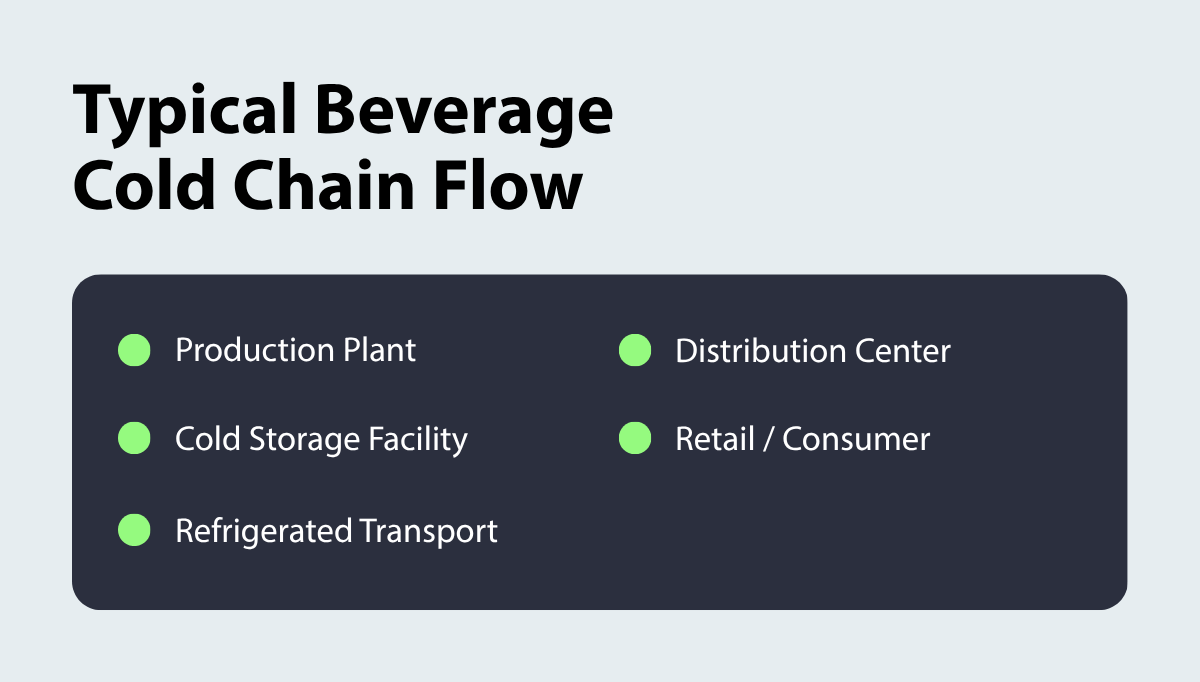
Plant (origin) → Cold storage → Temperature controlled transport (for transporting goods) → Distribution hub → Retail
Every handoff point in this chain is a potential failure point.For instance, a pallet sitting on a warm loading dock for 30 minutes. Or a reefer unit that was not pre-cooled before loading. maybe a mixed load that places temperature sensitive cargo next to dry freight. These are the situations where spoilage begins.
Thecold chain logistics market itself was valued at $371 billion in 2024 and is projected to reach $1.4 trillion by 2033. The food and beverage segment holds roughly 60% of that market. These numbers tell you something important: maintaining cold chain integrity is one of the fastest-growing operational priorities in global logistics.
Cold Storage: Warehousing for Temperature-Sensitive Goods
Cold storage facilities serve as the bridge between production and distribution. Effective cold storage operations use zone-based temperature controls, continuous monitoring systems, and strict inventory rotation protocols to protect product quality.
Temperature Zones in Beverage Warehousing
Different beverages require different storage conditions. The table below summarizes recommended temperature ranges, shelf life impact, and key risks for common beverage categories.
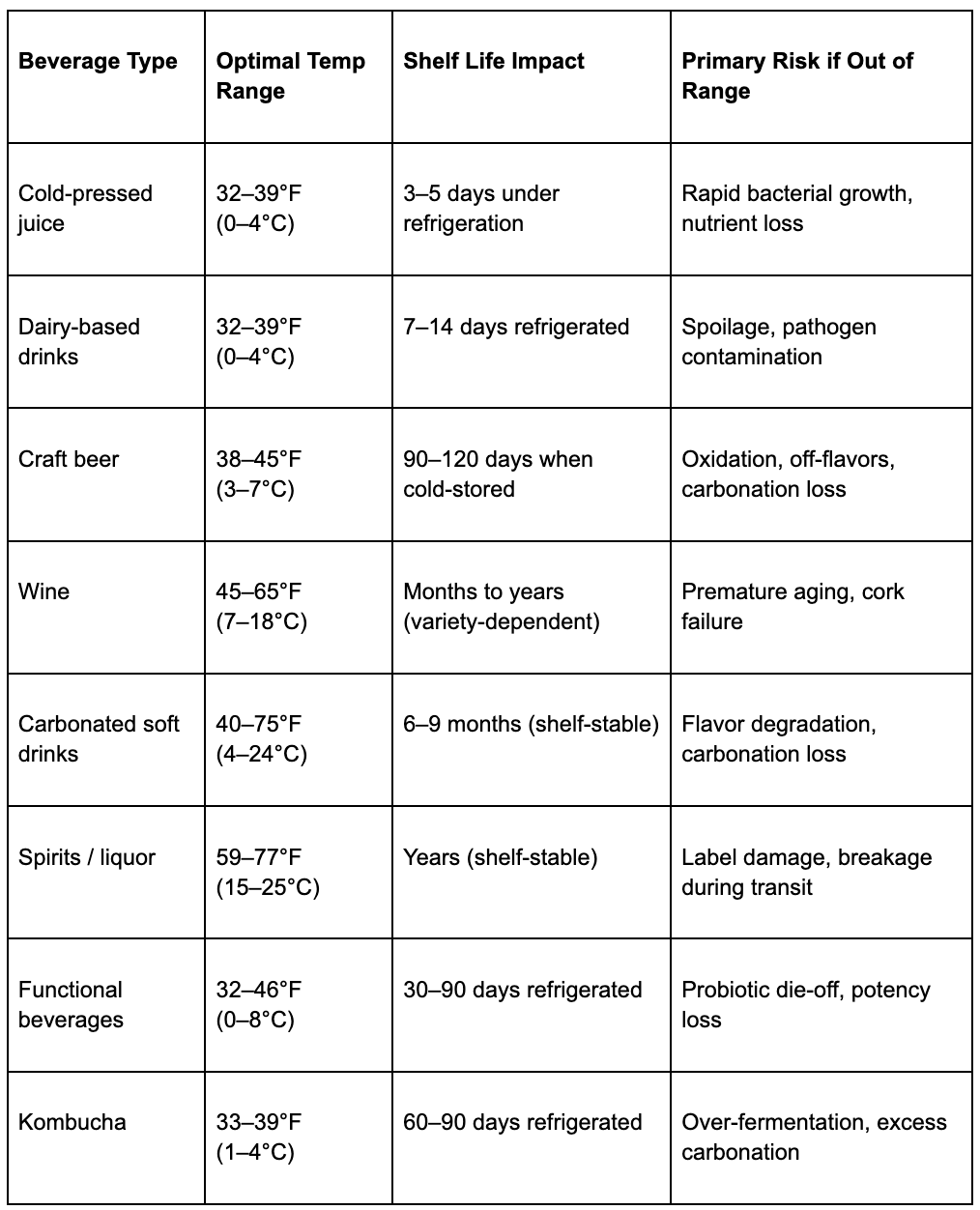
Note: Ranges are general guidelines. Always confirm the manufacturer’s specific temperature requirements before shipping.
Facilities must meet food-grade standards, including temperature and humidity controls that prevent spoilage for sensitive items like wine or craft beer. Using IoT sensors provides real-time alerts if storage temperatures deviate from required ranges.
Monitoring, Maintenance, and Inventory Management
Cold storage units should:
Log temperature continuously
Run daily equipment checks
Schedule preventive equipment maintenance
Proactive monitoring prevents heat exposure before it becomes a spoilage event.
Moreover, employing First-In, First-Out (FIFO) inventory methods is essential in beverage logistics to manage stock levels and minimize waste. FIFO ensures older inventory ships first, reducing the risk of expired product sitting in storage while newer stock moves out. Some operations also implement Just-In-Time (JIT) delivery to reduce warehousing time altogether and keep products moving quickly through the supply chain.
Cold Chain Transportation: Temperature Controlled Transit
Transportation is often the highest cost and highest risk stage of beverage logistics. Transportation often represents the largest expense in beverage logistics and requires precise execution to maintain profitability. It is also where cold chain failures most frequently occur. Moving products quickly is essential to meet tight delivery schedules and maintain supply chain fluidity. Temperature excursions during transit can happen in minutes and may not be discovered until delivery.
Transport Modes for Refrigerated Logistics
Common modes for temperature controlled beverage shipments include:
Refrigerated trucks for domestic routes
Reefer containers for ocean transportation
Air freight for urgent perishable goods
These vehicles must be properly equipped to maintain stable temperature during transport. Using refrigerated fleets with IoT monitoring is critical for maintaining cold chain integrity across any of these modes.
Refrigerated trucks are the workhorse of beverage distribution in North America. They require calibration, pre-trip inspections, and ongoing maintenance to maintain the desired temperature throughout a route.
Pre-Trip Inspections
Before dispatch:
Verify reefer unit calibration
Confirm set temperature requirements
Inspect door seals and airflow
Loading Procedures
To maintain proper handling:
Pre-cool cargo areas
Minimize door-open time
Avoid mixed loads with incompatible temperature sensitive products
Proper handling and loading procedures prevent temperature fluctuations during the most vulnerable moments of transit. These are the exact handoff points where products transition between controlled environments, and where trained personnel make the biggest difference.
Real-Time Monitoring for Temperature-Sensitive Goods
Visibility is now a key component in cold chain logistics. As the world goes through wars and disruptions, it's important for companies to keep track of all their cargo. Real-time monitoring technology gives shippers and logistics providers the ability to track product conditions continuously from pickup to delivery.
Modern cold chain logistics relies on IoT-enabled tracking.
IoT Sensors, GPS Tracking, and Alerts
Continuous logging devices provide:
Real time visibility into temperature
Alerts when limits are breached
GPS tracking during transportation
Alert thresholds should be configured around acceptable temperature ranges to minimize risk.
Centralized Dashboards
Centralized dashboards aggregate this from IoT data so logistics teams can:
Manage shipments proactively
Intervene before product loss occurs
Improve supply chain efficiency
When a temperature excursion is detected early for instance, intervention is possible before product loss occurs. This level of monitoring also supports supply chain efficiency. It helps identify patterns such as recurring problem lanes, underperforming carriers, or seasonal risk windows.
Advanced technologies like predictive analytics, blockchain-enabled traceability, and integrated GPS tracking across the network further strengthen cold chain performance. These tools help companies effectively manage temperature sensitive cargo while reducing operational cost.
Quality Control and Traceability Across the Supply Chain
Batch-Level Traceability
Each SKU should be traceable from origin to delivery. This ensures rapid recall capability if compliance issues arise.
Temperature Audit Protocols
Routine audits should include:
Random shipment inspections
Review of temperature logs
Validation of cold chain integrity
Deviation reporting workflows must be documented to support regulatory compliance.
Regulatory Compliance and Standards
Regulatory compliance is a structural requirement of operating in the beverage industry, and non-compliance fines can exceed $500,000 per incident.
FDA and FSMA Requirements
The FDA’s Food Safety Modernization Act (FSMA) includes a Sanitary Transportation Rule that establishes requirements for shippers, loaders, carriers, and receivers involved in transporting food by motor or rail vehicle. The rule covers vehicle design and maintenance, sanitary transportation procedures, temperature control protocols, carrier training requirements, and recordkeeping standards.
Under FSMA, carriers must demonstrate that transport equipment does not contaminate food during transit. Shippers bear primary responsibility for defining the conditions necessary to keep food safe. Written agreements between shippers and carriers must document who is responsible for sanitary conditions, temperature monitoring, and compliance documentation. Records must be retained for up to 12 months.
Beverage logistics must also comply with alcohol-specific transportation laws when shipping spirits, wine, or beer. This dual regulatory framework requires carriers to understand and follow both general food safety standards and category-specific rules.
HACCP, Traceability, and Documentation
Beyond FSMA, companies operating in the cold chain should follow HACCP (Hazard Analysis and Critical Control Points) principles to identify and control potential safety hazards proactively. End-to-end traceability systems ensure that every shipment can be tracked from origin to delivery, supporting rapid recall capability if compliance issues arise.
Required documentation includes temperature logs for every shipment, equipment maintenance records, cleaning and sanitation reports, and clear labeling of temperature sensitive goods. Agencies like the FDA and the World Health Organization (WHO) set standards that guide cold chain logistics companies in maintaining the right conditions for their products.
EU and International Transport Standards
For beverage brands that ship internationally, the ATP Agreement (Agreement on the International Carriage of Perishable Foodstuffs) is the governing framework across Europe and 50 signatory countries. Administered by the United Nations Economic Commission for Europe (UNECE), the ATP sets mandatory standards for insulated, refrigerated, and mechanically refrigerated transport equipment used in cross-border road and rail shipments.
All equipment must be inspected, tested, and certified every six years to confirm its thermal performance meets ATP classification requirements. Many European countries, including France, Spain, and Italy, have adopted ATP standards as the basis for their domestic cold chain legislation as well.
For U.S. based beverage companies exporting to Europe, understanding ATP certification requirements is essential to avoid shipment rejections at the border.
To ensure these rules are followed and compliance standards are met, companies must prepare documentation such as:
Temperature logs
Maintenance records
Cleaning and sanitation reports
Clear labeling of temperature sensitive goods is required to meet regulatory compliance obligations.
Temperature Controlled Packaging for Beverage Shipments
Packaging is the first physical barrier between a beverage product and the outside environment. Choosing cost effective packaging solutions that actually protect product integrity is essential.
Insulated Packaging Types
Common insulated packaging options include
insulated liners,
EPS foam boxes,
reusable insulated containers,
vacuum insulated panels.
For short-haul shipments, gel packs or dry ice maintain the right temperature for limited durations. Specialized packaging also helps prevent damage to fragile glass or aluminum containers during transit.
Packaging Validation
Before scaling operations, brands need to conduct time-and-temperature mapping tests. They must simulate extreme weather conditions and validate packaging duration for worst-case transit scenarios. This validation step is often overlooked, but it is the difference between a packaging design that works on paper and one that actually protects product quality under real-world conditions.
Quality Control and Traceability Across the Supply Chain
Batch-level traceability ensures that each SKU can be tracked from production through delivery. If a temperature excursion occurs, traceability systems allow companies to isolate affected product without pulling an entire production run.
Routine temperature audits should include random shipment inspections, review of temperature logs, and validation of cold chain integrity at each handoff point. Deviation reporting workflows must be documented to support regulatory compliance and protect consumer safety.
Effective cold chain logistics management involves ensuring visibility into operations. It also involves prompt risk mitigation and comprehensive reporting.
Best Practices: Maintain Temperature Control Across the Supply Chain
To maintain a resilient cold chain, companies should:
Standardize SOPs for temperature handling
Implement end-to-end temperature logs
Conduct periodic challenge tests
Schedule staff training programs
These measures help maintain product quality and ensure consistent control across the entire supply chain.
Training and SOPs for Temperature Sensitive Handling
Role-specific checklists should define:
Handling procedures for temperature sensitive shipments
Emergency response for refrigeration failure
Documentation steps for compliance
Regular competency assessments strengthen operational expertise and reduce risk.
Selecting a 3PL for Beverage Logistics (Temperature Controlled)
Choosing the right logistics partner for beverage shipments is one of the most consequential decisions a brand can make. The wrong provider leads to spoiled product, missed delivery windows, compliance violations, and lost customer trust. The right provider becomes an extension of your operations.
When evaluating a 3PL for temperature controlled beverage logistics, look for:
Beverage-specific experience: Do they understand the operational constraints of temperature sensitive goods, including weight density, breakage risk, and appointment compliance?
Refrigerated fleet access: Do they have reliable access to refrigerated trucks and reefer containers with verified cold chain logistics capabilities?
Real-time monitoring: Do they provide IoT-based tracking with real time visibility into temperature, location, and delivery status?
Compliance documentation: Can they produce validated temperature records, FSMA-compliant documentation, and audit-ready reporting?
Scalability: Can they handle seasonal demand spikes, new lane requests, and changing SKU mixes without service degradation?
Proactive communication: Do they alert you to issues before they become problems, or do you find out at delivery?
Strong 3PL partners offer scalable, flexible logistics solutions tailored to the unique needs of the beverage industry. Fast, on-time delivery is vital for building brand loyalty. Request documented temperature validation records and compare real time visibility tools before making a decision.
KPIs: Measure Shelf Life, Temperature Excursions, and Compliance
You cannot improve what you do not measure. Tracking the right key performance indicators helps brands and their logistics partners identify problems early, validate cold chain execution, and make better operational decisions.
Key metrics to track include:
Remaining shelf life at delivery: How much usable shelf life does the product retain when it reaches the receiver?
Temperature excursion rate: How many shipments experienced a temperature deviation outside validated parameters?
On-time delivery rate: What percentage of shipments arrived within the scheduled appointment window?
Damage and spoilage rate: What percentage of product was returned, rejected, or written off due to damage or spoilage?
Compliance audit pass rate: What percentage of shipments met full regulatory compliance requirements.
Monitoring these KPIs consistently supports supply chain efficiency, reduces spoilage, and builds trust between beverage brands and their logistics providers.
Risk Management and Contingency Planning for Cold Chain
A proactive risk strategy should include:
Backup cold storage locations
Spare refrigeration equipment
Emergency rerouting of refrigerated trucks
In case of deviation, recall procedures must protect customers and minimize spoilage.
Industry Use Cases: Alcohol, Juices, Carbonated Drinks, Wines, and Spirits
Craft Beer
Craft beer is one of the most temperature sensitive categories in the beverage industry. Flavor compounds break down rapidly outside the 38–45°F range. Even minor temperature changes impact carbonation, hop character, and mouthfeel. For craft breweries shipping regionally or nationally, cold chain control is a non-negotiable requirement.
Cold Pressed Juices
Cold-pressed juices are highly perishable and typically have a shelf life of just 3–5 days under proper refrigeration. Any break in the cold chain accelerates nutrient degradation and bacterial growth. These products demand continuous cold chain oversight from the moment they leave the production line
Carbonated Drinks
Many carbonated drinks are shelf-stable, meaning they can survive ambient temperature during transport. However, prolonged heat exposure can affect carbonation levels and flavor consistency. Stable storage and transport conditions still matter for preserving the product quality that consumers expect.
Wine and Spirits
Wine is particularly vulnerable to temperature swings. Heat exposure causes premature aging. Cold exposure risks cork contraction and oxidation. Spirits are more resilient but still require careful handling to prevent breakage and label damage. Beverage logistics must comply with both alcohol laws and general food safety standards when shipping these categories.
Implementation Checklist: Launch a Temperature-Controlled Beverage Supply Chain
Use this checklist to assess readiness before launching or upgrading a beverage logistics operation:
Define SKU-specific temperature requirements for every product in your portfolio.
Validate packaging for full transit duration, including worst-case weather scenarios.
Onboard a 3PL partner with documented cold chain capabilities, clear SLAs, and measurable KPIs.
Implement end-to-end temperature monitoring with IoT sensors and centralized dashboards.
Establish FSMA-compliant documentation workflows for every shipment.
Schedule quarterly cold chain performance reviews with your logistics provider.
Build a Beverage Logistics Strategy That Protects Your Product
Effective beverage logistics depends on a coordinated cold chain strategy. Temperature control, proper handling, real-time monitoring, and strict regulatory compliance are the pillars that protect shelf life, reduce spoilage, and ensure consistent product quality at delivery.
In a competitive supply chain environment, the brands that partner with providers who understand beverage-specific constraints will outperform those that treat beverage freight like any other commodity. The right temperature is the right strategy. And the right logistics partner makes it possible.
Ready to improve your beverage logistics? Talk to the Forsla team about building a cold chain strategy tailored to your product portfolio and distribution network.
Frequently Asked Questions
How do IoT sensors improve cold chain logistics?
IoT sensors provide continuous temperature logging, automated alerts when limits are breached, and GPS tracking during transportation. They give logistics teams real time visibility to intervene before product loss occurs and support audit-ready compliance documentation.
What should I look for in a beverage logistics provider?
Look for experience with temperature sensitive goods, access to refrigerated trucks, real-time monitoring capabilities, FSMA-compliant documentation, scalable capacity for seasonal demand, and proactive communication. Request validated temperature records and compare visibility tools before choosing a partner.
How does proper packaging protect temperature sensitive goods?
Insulated packaging solutions such as EPS foam boxes, gel packs, dry ice, and vacuum insulated panels maintain the desired temperature during transit. Packaging must be validated against worst-case transit durations and weather conditions to ensure it performs under real-world stress.
What are common causes of cold chain failure in beverage logistics?
Frequent causes include reefer units not pre-cooled before loading, prolonged door-open time during handoffs, mixed loads with incompatible temperature sensitive products, carrier equipment failures, and gaps in monitoring coverage. Most failures happen at transition points between controlled environments.
How much does spoilage cost the beverage industry?
The FAO estimates that 14% of food produced globally is lost before reaching retail, costing approximately $400 billion annually. For beverage brands, spoilage drives product write-offs, reverse logistics expenses, and lost customer trust. A strong cold chain is the most effective way to reduce these costs.
What is FIFO and why does it matter in cold storage?
FIFO stands for First-In, First-Out. It means the oldest inventory ships before newer stock. In cold storage for perishable beverages, FIFO prevents expired product from sitting in a warehouse while fresher product ships, reducing waste and protecting shelf life.